When a rubber product is specified, hardness is one of the first numbers on the list. This guide explains what it means, what typical values feel like and how to specify it. Hardness values here are general references and not specifications of any one product of ours; if you need a figure, tell us and we will agree it for your order.
What Shore A measures
Shore A hardness measures how far a small spring-loaded needle presses into the rubber under a set force. The reading runs from 0 (very soft) to 100 (hard). It is measured with a durometer, a handheld gauge, according to standards such as ISO 868, ASTM D2240 and the Chinese GB/T 531.1. A few tenths of a second after the needle touches the surface, the reading is taken.
Typical values
| Everyday object | Approx. Shore A |
|---|---|
| Rubber band | 25–30 |
| Pencil eraser | 40–50 |
| General-purpose moulded rubber goods | 50–70 |
| Car tyre tread | 60–70 |
| Shoe heel | 80 |
| Hard industrial wheel | 90+ |
How hardness affects a rubber bucket
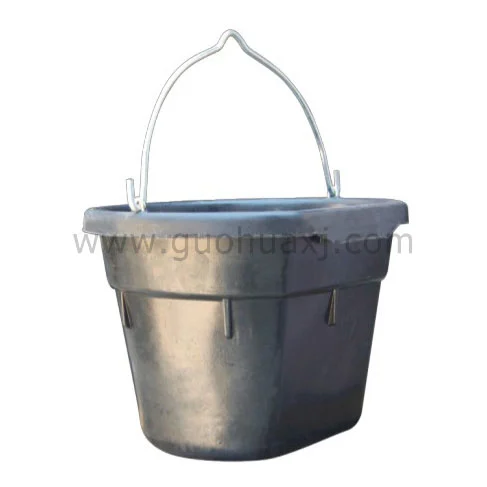
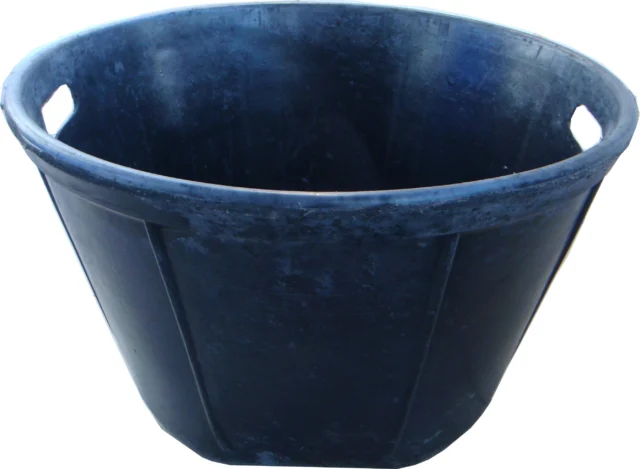
A softer compound is more flexible. The bucket gives under a knock and is easier to squeeze, which helps when emptying frozen water or crushed material. A harder compound holds its shape better, supports more load without sagging and resists cuts and abrasion. For buckets and tubs a medium hardness is usually a good compromise; the wall thickness also matters, because a thick wall of soft rubber can be as stiff as a thin wall of harder rubber.
How hardness affects a rubber base
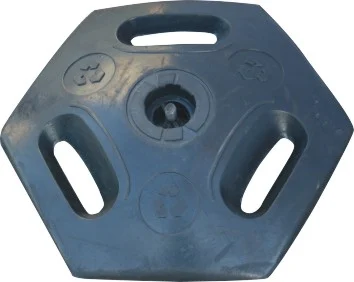
Rubber bases for posts and stanchions need grip and some firmness so that the post sits straight. A softer base grips better on smooth floors and is kinder to tiles; a harder base is more stable and wears more slowly under traffic. See rubber bases for posts and stanchions for the other factors.
Hardness and temperature
Rubber gets stiffer in the cold and softer when it is warm, so the same product reads a little differently on a winter morning and in summer. Standard tests are made at about 23 °C. If your product has to be flexible at a low temperature, tell us the lowest temperature as well as the hardness.
Testing in our laboratory
Our rubber laboratory has hardness testers, together with compression and tensile testing machines, which we use to check hardness against the requirement. See quality control.
How to specify hardness in an order
- State a range, for example 60 ± 5 Shore A, and not a single number.
- Name the test standard and the conditions, for example ISO 868 at 23 °C.
- Send a sample if you have one and want to match it.
Send your requirements and we will confirm what is practical.